Showing posts with label politics. Show all posts
Showing posts with label politics. Show all posts
Wednesday, July 24, 2024
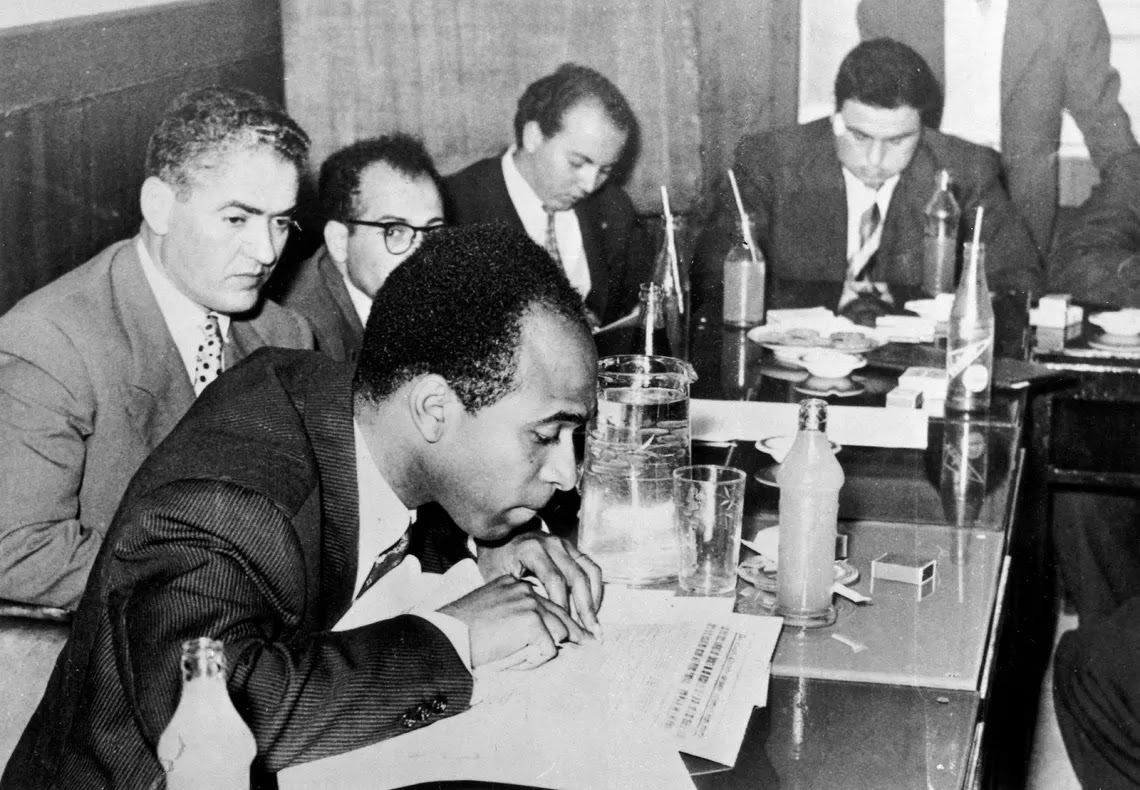
Fanon the Universalist / The New York Review / Susan Neiman
"Fanon came to believe that colonialism was a system of pathological relations masquerading as normality."
Adam Shatz argues in his new biography of Frantz Fanon that the supposed patron saint of political violence was instead a visionary of a radical universalism that rejected racial essentialism and colonialism.
June 6, 2024 issue


Thursday, November 30, 2023
Henry Kissinger, the Hypocrite - Opinion Guest Essay By Mr. Rhodes is a former deputy national security adviser.

Tuesday, April 11, 2023
Monday, January 16, 2017
Thursday, August 30, 2012
Voters return Ford to mayor’s office By GUY RHODES and JACQUELYN CARLISLE Updated Aug 30, 2012 - 06:08:32 EDT
In 1972 Johnny Ford was the youngest and first black man elected
mayor of Tuskegee. Tuesday, Aug. 28 he became the oldest, or as he says,
the wisest to be elected at age 70.
Ford resurrected his political career for at least four more years by defeating incumbent Omar Neal who had upended Ford in 2008 when Ford was seeking reelection.
In 2010 Ford unsuccessfully ran for the Alabama Senate, losing to Billy Beasley of Clayton. A year ago Ford announced he was going to run for the District 2 seat on the Tuskegee Council because incumbent Louise Fields decided not to run for reelection. Several months Ford changed his mind and decided to run for an eighth term as mayor.
Ford served as mayor consecutively from 1972-96 before losing his bid for a seventh straight term to Ron Williams.
Ford pulled 1,362 (57 percent) votes to 912 for Neal (38 percent). Pearl Riley-Franklin was a distant third with 115 votes (5 percent).
“What’s important is to work with what’s in place. A lot of that has happened the past four years is a carryover from what we started,” Ford said in reference to his most previous term as mayor from 2008. “I’m willing to work and compromise with those on the council.”
Georgette White-Moon, District 3, is the only member of the current council reelected Tuesday. Mae Doris Williams lost out in her effort to retain her at-large seat where Shirley Curry and Tony Haygood will be in a runoff. Chris Lee won the District 1 seat over four opponents and Ala Whitehead took the District 2 position.
“I am so appreciative for the time I have served the citizens of Tuskegee” Neal said from his headquarters. “The Creator has something else for me at this time and I will accept His will. I will continue to serve the community and my love for Tuskegee is unconditional and unwearied. I want to thank my supporters and congratulate Johnny Ford.”
. At his campaign headquarters on the Square in downtown Tuskegee Ford received congratulations from supporters, many of whom have been in camp for numerous election victory nights.
Neal visited Ford’s headquarters to offer congratulations.
“I told him I remembered doing the same thing four years ago when he was successful in being elected and offered to make it a smooth transition. He promised to do the same,” the mayor-elect commented.
Ford said one of his concerns going into the election was how Tuskegee University students would vote. Many observers believe the student vote helped put Neal in office in 2008.
“There’s an uncertainty with how many students will vote and how they will vote,” Ford explained. “I really worked hard on campus the past few weeks.”
The turnout Tuesday of 2,077 was slightly less than the number of voters in the first vote in 2008 when 2,389 voted when there were five mayoral candidates. A total of 2,733 participated in the runoff between Ford and Neal.
 The
mayor-elect plans to address issues such as lowering utilities rates,
getting the Tuskegee VA Hospital recognized as a National Historic Site,
securing a Critical Access Hospital (CAH), reopening of VictoryLand,
securing other business and industry and developing Exit 38 on I-85.
The
mayor-elect plans to address issues such as lowering utilities rates,
getting the Tuskegee VA Hospital recognized as a National Historic Site,
securing a Critical Access Hospital (CAH), reopening of VictoryLand,
securing other business and industry and developing Exit 38 on I-85.
Ford resurrected his political career for at least four more years by defeating incumbent Omar Neal who had upended Ford in 2008 when Ford was seeking reelection.
In 2010 Ford unsuccessfully ran for the Alabama Senate, losing to Billy Beasley of Clayton. A year ago Ford announced he was going to run for the District 2 seat on the Tuskegee Council because incumbent Louise Fields decided not to run for reelection. Several months Ford changed his mind and decided to run for an eighth term as mayor.
Ford served as mayor consecutively from 1972-96 before losing his bid for a seventh straight term to Ron Williams.
Ford pulled 1,362 (57 percent) votes to 912 for Neal (38 percent). Pearl Riley-Franklin was a distant third with 115 votes (5 percent).
“What’s important is to work with what’s in place. A lot of that has happened the past four years is a carryover from what we started,” Ford said in reference to his most previous term as mayor from 2008. “I’m willing to work and compromise with those on the council.”
Georgette White-Moon, District 3, is the only member of the current council reelected Tuesday. Mae Doris Williams lost out in her effort to retain her at-large seat where Shirley Curry and Tony Haygood will be in a runoff. Chris Lee won the District 1 seat over four opponents and Ala Whitehead took the District 2 position.
“I am so appreciative for the time I have served the citizens of Tuskegee” Neal said from his headquarters. “The Creator has something else for me at this time and I will accept His will. I will continue to serve the community and my love for Tuskegee is unconditional and unwearied. I want to thank my supporters and congratulate Johnny Ford.”
. At his campaign headquarters on the Square in downtown Tuskegee Ford received congratulations from supporters, many of whom have been in camp for numerous election victory nights.
Neal visited Ford’s headquarters to offer congratulations.
“I told him I remembered doing the same thing four years ago when he was successful in being elected and offered to make it a smooth transition. He promised to do the same,” the mayor-elect commented.
Ford said one of his concerns going into the election was how Tuskegee University students would vote. Many observers believe the student vote helped put Neal in office in 2008.
“There’s an uncertainty with how many students will vote and how they will vote,” Ford explained. “I really worked hard on campus the past few weeks.”
The turnout Tuesday of 2,077 was slightly less than the number of voters in the first vote in 2008 when 2,389 voted when there were five mayoral candidates. A total of 2,733 participated in the runoff between Ford and Neal.
Tuesday, July 17, 2012
Wednesday, May 30, 2012
Monday, May 21, 2012
Church And State In America Roger Williams, and the history that set the table.

Roger Williams (National Park Service)
But long before Jefferson there was Roger Williams, fighting for Soul Libertie. Warning that when church and state entwine, it is the soul that suffers. The church that should be wary. In our time of Romney, Santorum and Obama, this history resonates.
This hour, On Point: Roger Williams and the creation of the American soul.
-Tom Ashbrook
Thursday, April 5, 2012
Saturday, March 31, 2012

Sunday, March 4, 2012

Saturday, February 25, 2012
Saturday, February 4, 2012
Saturday, January 28, 2012
Wednesday, January 25, 2012

Sunday, January 22, 2012
Saturday, January 7, 2012
Friday, December 30, 2011
Thursday, December 22, 2011

Subscribe to:
Posts (Atom)
-
A Hollow Inheritance: The Legacies of the Tuskegee Civic Association and the Crusade for Civic Democracy in Alabama by Gabriel Antoine Smi...
